


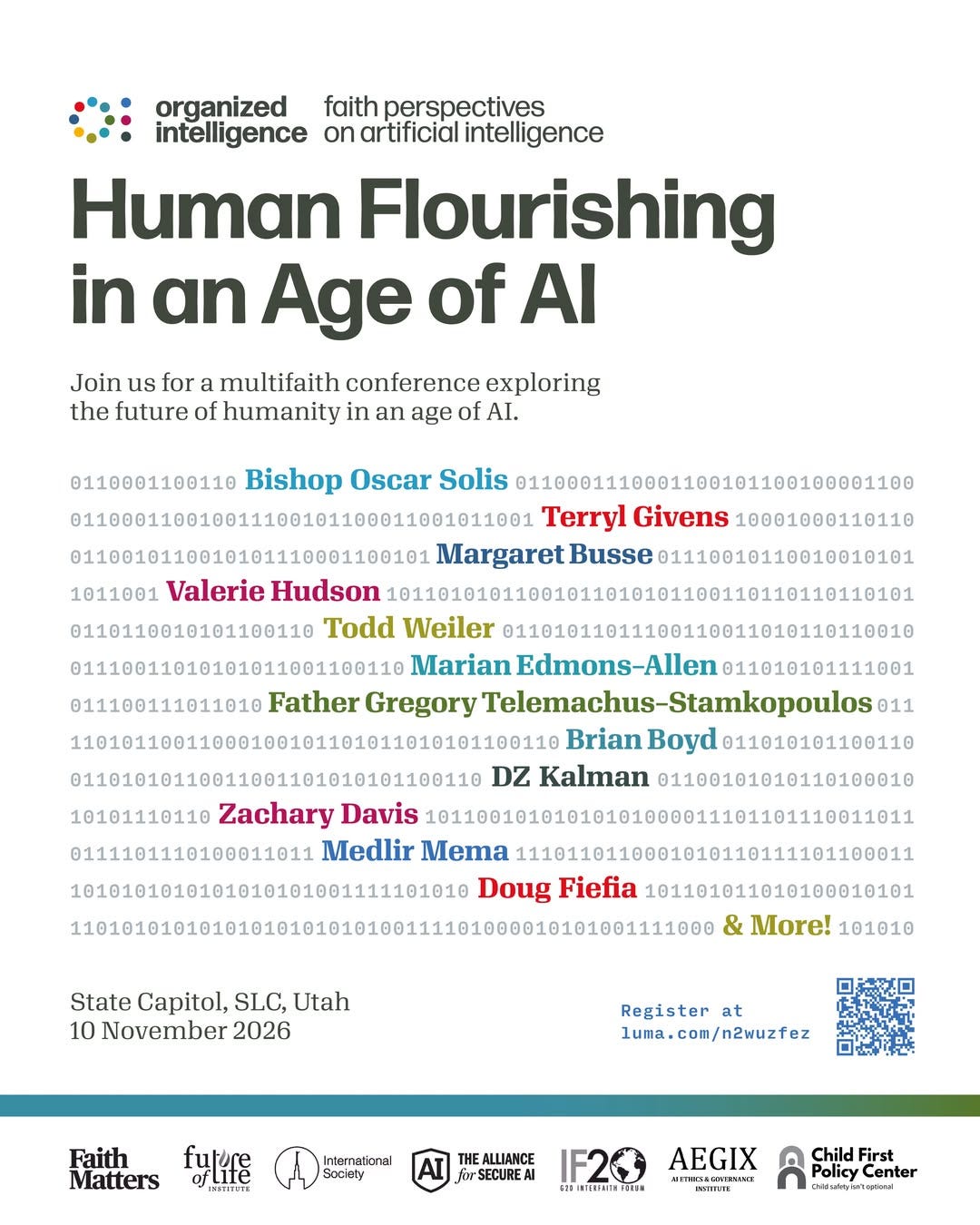
At next week’s Organized Intelligence conference, Valerie Hudson will present her vision for a new magna carta for AI. You can read her introduction below:
On 30 September, a Quinnipiac poll of American adults found that 91% want guardrails for AI, 73% feel that AI could potentially harm humans, and 86% want independent safety standards as 74% did not trust AI companies. That’s a pretty damning but apropos judgment on an industry that simultaneously promises that AI will solve humanity’s problems but also that AI could potentially threaten human extinction. Furthermore, the poll showed that women—the maintainers of human life—were much more negative in their views than men.
Since the OpenAI/Hugging Face incident and the discovery of similar cases that went undetected for months, many, including the leaders of AI companies, are finally raising the alarm on AI safety, arguing that it is time to leave behind an ethos of “move fast and break things” in favor of a stance more consonant with human survival. Bill Gates is on record as saying, “[T]here’s never been a product that’s less understood in terms of what its capabilities are than A.I. And A.I. has crossed the threshold that its ability to empower a bioterrorist to kill hundreds of millions — that exists today. The ability to do a cyberattack that scrambles all of the bank accounts, shuts down the electric grid — that exists today, and we know that’s the case. . . we crossed the cyber threshold and we crossed the bio threshold early this year. . . This is the most dangerous thing that humans have ever gone near.”
While some have argued this stance is merely an attempt at preemptive regulatory capture, I suggest these two things can be true at the same time; that is, the risks have become apparent in an undeniable fashion, and in the face of this fact, AI companies are seeking to steer regulation. What is worse, unlike other examples of dangerous technology, such as nuclear weapons, the government did not develop AI and does not have the level of technical expertise that the frontier labs possess—at least at the moment—to do what needs to be done to mitigate the risk AI poses.
This is a pivotal moment. Who gets to decide what risks the United States will accept, especially as these risks may prove existential? Though I do not agree with him on many things, Bernie Sanders, the independent senator from Vermont, speaks for me when he says, “We can’t allow a handful of greedy people to play God and determine the future of humanity – our economy, environment, democracy, privacy and more – without public input.”
It is time for the public and its elected representatives to set America’s Terms and Conditions for Artificial Intelligence. These companies have set terms and conditions for the rest of us for a long time, and it’s high time we finally set terms and conditions for them. These Terms and Conditions can also be viewed as a foundational declaration of rights of citizens and governments vis a vis AI companies, a type of AI Magna Carta to limit what has been assumed to be unlimited power of AI companies to operate as they see fit. In 1215, the original Magna Carta sought to limit the power of the king; the AI Magna Carta of 2026 seeks to limit the power of those who develop and market an existential risk to our species.
This effort unites citizens and their government in common purpose, and it is increasingly clear that humankind’s continued existence depends on setting aside political differences to get it done. As the previously cited poll figures demonstrate, this is a 90% issue with the American public. Other countries, such as China, the EU, and India—and US states such as Florida, California, and Utah—have all pioneered initiatives on governance of AI to prevent and mitigate harm from AI, and we can take inspiration from those efforts. We can do this.
The full document will be unveiled at OI26.
ORGANIZED INTELLIGENCE 2026 SPEAKERS


ABOUT OI26
OI26: Human Flourishing in an Age of AI brings together faith leaders, scholars, technologists, policymakers, educators, and civil society leaders in Utah for a public, multifaith conversation about the human future in an age of artificial intelligence.
Questions about AI cannot be answered through technical expertise alone. Religious and wisdom traditions have spent centuries wrestling with questions of human dignity, agency, meaning, relationships, responsibility, community, and the common good. OI26 brings these perspectives into conversations with leaders working at the forefront of technology, public policy, education, and civil society.
The program will also focus on the places where AI intersects with everyday life: families and relationships, education, work, privacy and human dignity, mental health and social connection, and civic institutions.
OI26 invites us to look beyond what AI can do and consider what technological progress should ultimately serve.
AGENDA
9:00-9:20 | Opening Plenary
“Human Flourishing in an Age of AI”
Convener: Medlir Mema
An introduction to OI26’s central question: How can we ensure that AI advances human flourishing? The session frames the opportunities and challenges of emerging technologies and highlights the importance of human dignity, agency, relationships, and moral responsibility in shaping a pro-human AI future.
9:20–9:25 | Musical Number
9:25–9:50 | Opening Keynote
“What Does Human Flourishing Look Like in an Age of AI?”
Speaker: Bishop Oscar Solis (SLC Utah Catholic Diocese)
Drawing on Pope Leo XIV’s Magnifica Humanitas, Bishop Solis reflects on what it means to preserve human dignity, agency, relationships, and the common good as AI increasingly shapes human life.
9:50–10:15 | Plenary Address
Speaker: Terryl Givens
10:15-10:30 | Break
10:30–11:15 | Multifaith Dialogue
“Faith, Wisdom, and the Moral Architecture of AI”
Participants: Zachary Davis (moderator), Marian Edmonds-Allen, Geoff Mittleman, Father Gregory Telemachus-Stamkopoulos, DZ Kalman
What can religious and wisdom traditions teach us about human dignity, agency, meaning, relationships, responsibility, and the responsible exercise of technological power?
11:15–12:15 | OI Conversations
“Where AI Meets Human Flourishing”
Speakers: Michael Toscano, Erika Anderson
An exploration of how AI intersects with the various dimensions of human flourishing, from family relationships, education, and meaningful work to privacy, dignity, and mental well-being.
“Building a Pro-Human AI Coalition”
Participants: Nico Zviovich (moderator), Corinne Johnson, Clara Long, Marianna Richardson, Ray Kim
Faith, policy, technology, and civil-society leaders discuss practical models for sustained collaboration beyond the conference.
12:15–1:15 | Lunch
1:15–1:40 | Featured Address
“A New Magna Carta for an Age of AI”
Speaker: Valerie Hudson
Connecting moral principles to the practical realities of increasingly capable and autonomous AI systems.
1:40–2:10 | OI Conversations
“Public Institutions in the Age of AI”
Speakers: Doug Fiafie, Jeannie Johnson
Examining the role of states, legislatures, educational institutions, and other public bodies in ensuring that innovation strengthens human flourishing while preserving dignity, agency, families, communities, and the common good.
2:10–2:30 | Distinguished Address
“Governing for Human Flourishing: Innovation, Trust, and the Public Interest”
Speaker: Margaret Busse, Commissioner, Utah Department of Commerce
Drawing on Utah’s approach to AI policy, Commissioner Busse explores how the government can create space for technological experimentation while establishing safeguards that protect people, strengthen trust, and keep human well-being at the center of AI policy.
2:30–2:45 | Break
2:45-3:30 | OI Conversation
“Where AI Meets Human Flourishing”
Speakers: Melissa McKay, Matt Miles
An exploration of how AI intersects with the various dimensions of human flourishing, from family relationships, education, and meaningful work to privacy, dignity, and mental well-being.
3:30–3:50 | Plenary Address
“From Principles to Action: AGI, ASI, and the Human Future”
Speaker: Brian Boyd (FLI)
A forward-looking conversation about increasingly capable AI systems, long-term risks, human agency, and what society should begin preparing for now.

Val, You provide the right diagnosis, and the bones of legal restraints, but I think we need more than a Magna Carta for America. We need a new set of Geneva Conventions to make 'certain conflicts employing harmful AI' regulated as war crimes. It looks like (as you note) governments do not control--nor ever will--the use of AI by bad actors. The costs are too cheap and access too available to prevent all horrible events that are too likely ahead. The idea of mutually assured destruction is still plausible to deter major states, but madmen or nihilistic terrorists are more likely capable of mass destruction now. We need to plan on the worst happening by such people, and in addition to Geneva Conventions, we need an international protocol for a collective response that will mitigate the damage. Otherwise the great powers will quickly blame each other and exacerbate the disaster. Best wishes, Randall