


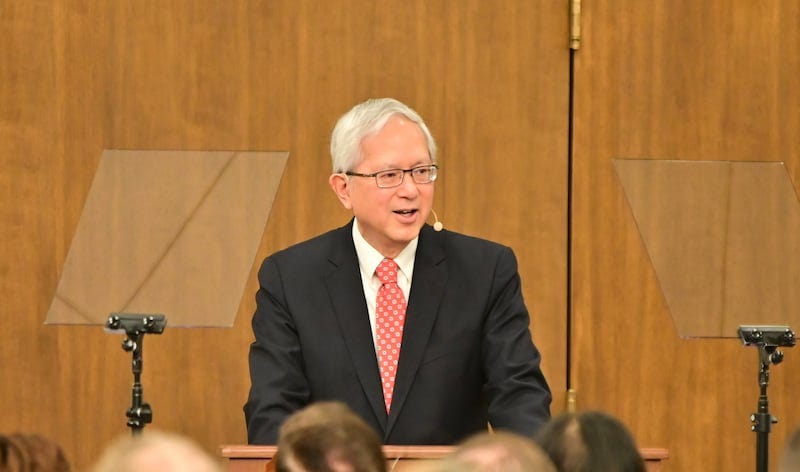
On Nov. 5, in a harshly lit conference room at The Church of Jesus Christ of Latter-day Saints’ main administrative hub in Salt Lake City, Elder Gerrit Gong delivered an impassioned speech about the future of AI.
“Man can create AI, but AI cannot create God,” he told the assembled audience.
Gong was speaking at a conference put together by Organized Intelligence, an initiative not directly associated with the church but one that advances Latter-day Saint perspectives on AI, namely that these tools are safe, properly regulated and don’t impede or replace users’ relationship with morality or God.
Gong, who is one of the 12 Apostles of the church, has spent much of the last year thinking and speaking about this rapidly evolving technology. A former State Department official and Oxford-trained Rhodes Scholar, he is able to discuss AI at a technical level or a more abstracted one. And he is the public face of a concerted Latter-day Saint effort to begin to take seriously the risks associated with AI development.
Over the course of two days at the Organized Intelligence conference, Latter-day Saint leaders weren’t the only ones taking the stage. The speakers included officials from the Future of Life Institute, which works to reduce existential risk from advanced AI, historians from around the country and the executive director of Utah’s Department of Commerce. As quickly became apparent, there is a fast-growing collection of people and interests in Utah who are deeply focused on the future of AI.
Top officials in the state have also shown no hesitation when it comes to going up against the agenda of Big Tech — or the industry’s allies in the Trump administration.
The state Legislature has been aggressive about trying to impose new restrictions on social media companies, leading to a protracted fight that continues to play out in the courts. More recently, Utah GOP Gov. Spencer Cox has drawn the ire of major online prediction market companies — and the attention of their lawyers — after he and Utah Attorney General Derek Brown vowed to make sure their apps were illegal in the state. But it’s the debate over AI that has made Utah the epicenter in the fight for regulation of a technology that its biggest boosters and critics alike say could transform life as we know it.
“Utah being a majority Latter-day Saints state, it has a unique way of doing politics,” said Medlir Mema, the executive director of Organized Intelligence and a Latter-day Saint himself. “It has this mantra about ‘disagreeing better.’”
Utah officials say they’re trying to find a middle ground on AI — guided by faith and morality while also embracing modernity. If they succeed, they could prove to be a national model for tech development and safety. But first, the state will have to find its way out of the crosshairs of the White House.
Utah stumbled into its clash with the Trump administration in January, after GOP State Rep. Doug Fiefia introduced HB 286. A sweeping piece of legislation, it was aimed at increasing transparency and building safeguards around frontier AI models, requiring companies to post public safety and child protection plans on their websites and report safety issues to Utah’s policy office. It also established civil penalties for offenders and protections for whistleblowers.
But after weeks of public debate on the bill, the Trump administration stepped in with a directive: Stop.
“We are categorically opposed to Utah HB 286 and view it as an unfixable bill that goes against the Administration’s AI Agenda,” the entirety of the letter read.
President Donald Trump has embraced Silicon Valley’s efforts to unleash AI and signed an executive order in December designed to preempt any state regulations on AI with a potential federal standard, one that critics are concerned will amount to no regulation at all. Trump’s influential AI czar David Sacks, a venture capitalist by trade, has pushed the federal government away from regulating AI, a move he believes would stifle growth.
