


Deseret News reporter Ariel Harmer reported on this year’s Organized Intelligence gathering. You can find her story below.
Interfaith and political leaders convened in Salt Lake City this week to discuss a pressing question: As the world moves forward with AI, how can humans thrive rather than fall behind?
One organization offers up some ideas. The OI26: Human Flourishing in the Age of AI summit was held at the Utah state Capitol on Tuesday. Speakers included members of the Utah House and Senate, academics and professors from several universities, and faith leaders from multiple traditions.
“We are not at the mercy of what may happen next,” the Rev. Marian Edmonds-Allen said in an interfaith panel at the conference.
“We have agency, we have wisdom, we are blessed by the indescribable uniqueness of our humanity, and we are in charge of our own technology use.”
Speakers at the conference discussed a range of topics related to AI, including its intersection with families and relationships, education, work, privacy and human dignity, mental health and social connection, and civic institutions.
Overall, the conference invited attendees to consider not just what technology can do but also what purpose its progress should serve.
Religion: Humanity’s original technology
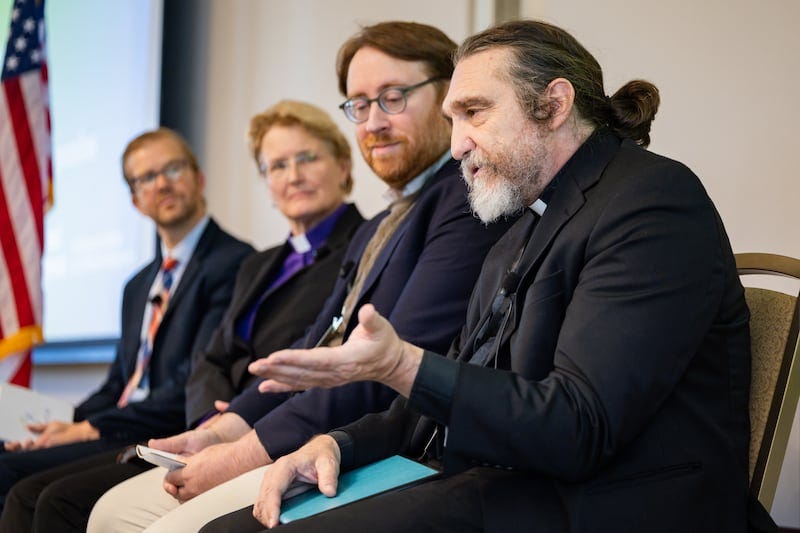
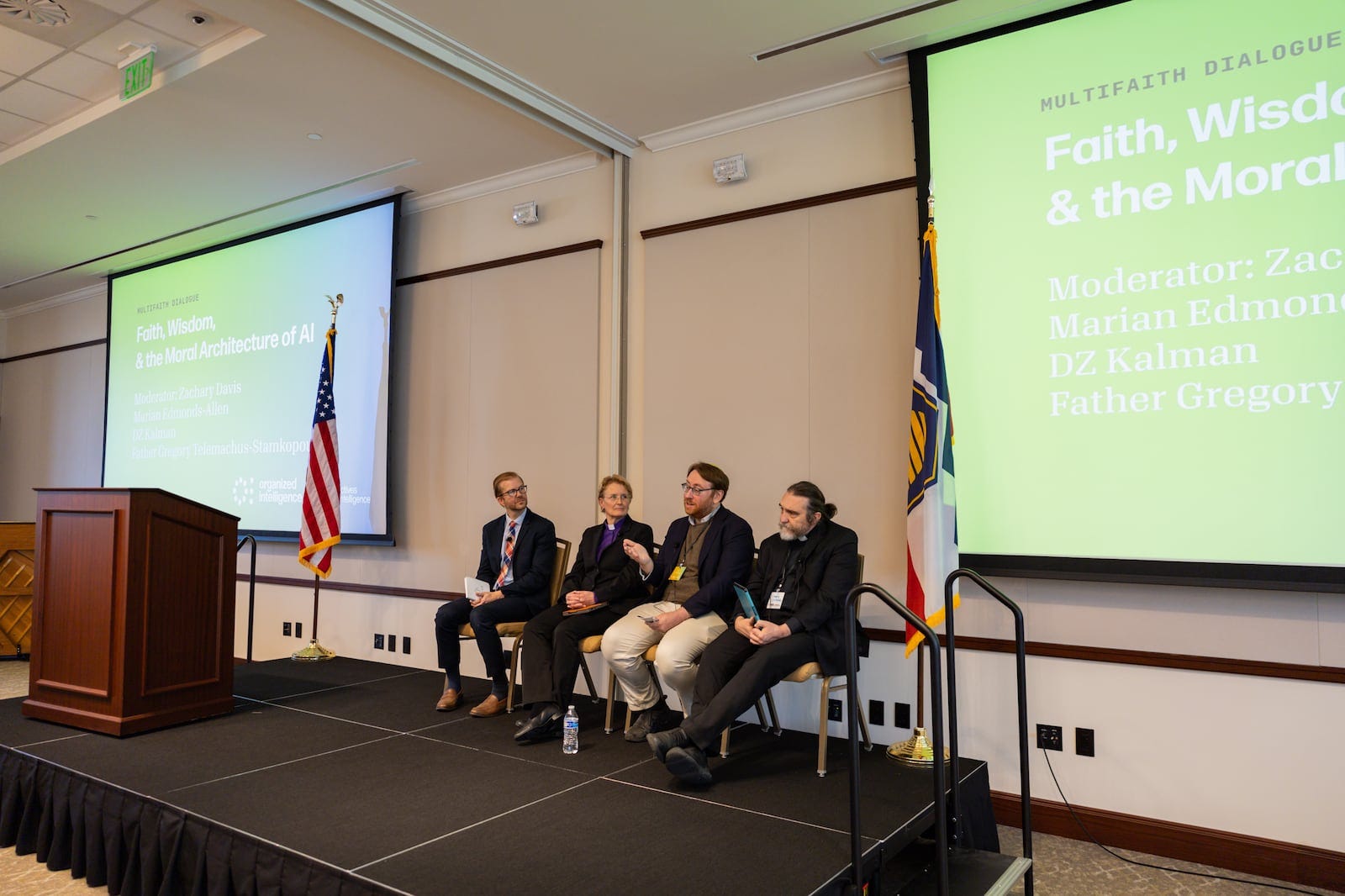
Zachary Davis, executive director of Faith Matters, moderated an interfaith panel that included the Rev. Edmonds-Allen of FaithWise.AI; DZ Kalman, a fellow at Harvard University’s Berkman Klein Center for Internet & Society and the author of the Substack “Jello Menorah”; and Father Gregory Telemachus-Stamkopoulos of the Greek Orthodox Archdiocese of America.
Davis began the panel by announcing an “exciting technology” that can answer the big questions of life, has ingested thousands of years of human data and has a product fit in every market on Earth.
The name of this technology?
“Religion,” Davis said. “Religion is what humans and God have co-created to help us answer those big questions.”
He introduced the three panelists as “engineers” of this tech who explore how religion can shape humanity’s understanding of and response to AI.
The Rev. Edmonds-Allen shared a few examples of ways AI could extend humanity’s gifts and allow us to achieve our goals. However, she acknowledged the harm AI use can cause, including losing the ability to do certain cognitive tasks and having negative effects on relationships. It’s therefore essential to use our moral compass along with technological tools, she said.
“Consider who you might help to take advantage of the technology that surrounds us, but with human wisdom and values firmly in control of that technology,” she said. “Is there hope for human flourishing in the age of AI? Well, that’s up to us.”
Father Telemachus-Stamkopoulos shared his experience working with early artificial intelligence decades ago and posed a question he said is rarely asked in engineering spaces: “Does becoming more intelligent necessarily mean becoming wiser?”
Don’t fear technology, he said, but remember what makes you human.
“The ultimate measure of technological progress is not how powerful our machines become but how deeply human our civilization remains,” Father Telemachus-Stamkopoulos said.
Kalman emphasized the role of religion in navigating technological change. If religious groups want to be a moral force in the world, they need to continually engage with technology and global issues, he said. Religious groups can help individuals express their concerns and ideas and establish ethics and standards.
“Religious groups, I think, are the key to solving the most important question about AI of all, which is: What is this? What is this morally? Is this a person?” he said. “Answering questions around personhood, around notions of the soul, around notions of moral status, those are questions that religious groups really need to be in the room to engage in.”